

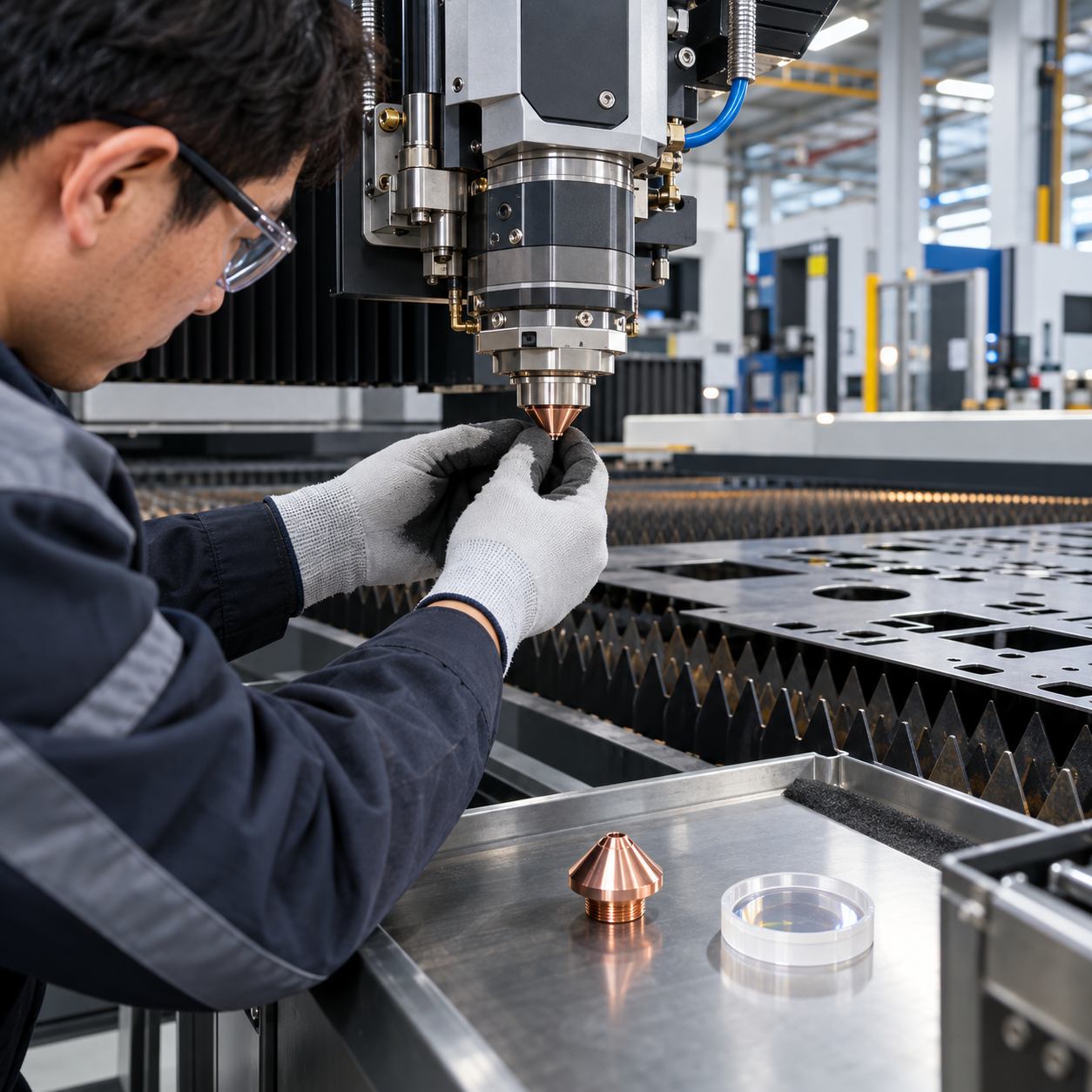
Laser cutting nozzles and protective lenses are small consumable parts, but they have a direct impact on cutting quality, machine stability, and operating cost.
Many operators ask the same question: how often should they be replaced?
The answer is that there is no universal replacement interval. The service life of laser cutting consumables depends on laser power, material thickness, cutting gas, production hours, contamination, nozzle collisions, and maintenance quality.
Instead of replacing parts only according to a fixed schedule, manufacturers should combine regular inspection with actual cutting performance.
The nozzle and protective lens perform different functions inside a fiber laser cutting system.
The nozzle helps control the auxiliary gas flow around the laser beam and cutting zone. Its condition can affect:
The protective lens protects the internal optics from dust, smoke, spatter, and other contamination.
TRUMPF explains that protective glass keeps spatter, smoke residue, steam, and other impurities away from the optical system. Clean, high-quality protective glass is important for stable beam transmission and cutting performance.
There is no single replacement period suitable for every factory.
In some production environments, a nozzle may work reliably for many shifts. In demanding applications, it may need replacement much sooner.
TRUMPF notes that cutting nozzles are consumable parts that eventually wear out, and nozzle life can be strongly affected by contact or collision with the workpiece.
The actual service life depends on several factors.
1. Nozzle Collision
A collision between the nozzle and the sheet can deform the nozzle opening.
Even a small deformation may disturb gas flow and affect cutting quality.
After a collision, operators should inspect:
If the nozzle is visibly damaged, replacement is usually safer than continued use.
2. High Production Load
Machines operating for multiple shifts per day generally consume nozzles faster than machines used occasionally.
High production volume means more:
This is why replacement intervals should be based on operating conditions rather than calendar time alone.
3. Thick Plate Cutting
Thicker materials usually require higher gas pressure, longer piercing, and more demanding cutting conditions.
This can increase thermal and mechanical stress around the nozzle.
Factories processing thick carbon steel or stainless steel should inspect nozzles more frequently.
4. Poor Nozzle Alignment
The laser beam should remain correctly centered through the nozzle.
If the nozzle becomes misaligned, cutting gas distribution may become uneven.
This can result in:
After replacing a nozzle, nozzle alignment should be checked according to the cutting head and machine requirements. TRUMPF maintenance training specifically includes nozzle alignment as a standard cutting-head maintenance task.
A nozzle should be inspected or replaced if you notice:
If cutting quality suddenly changes even though power, speed, focus, and gas pressure remain unchanged, the nozzle should be one of the first components checked.
Protective lenses should also be replaced based on condition rather than a fixed number of days.
A clean protective lens allows laser energy to pass through efficiently while protecting the more expensive optical components inside the cutting head.
Contamination may gradually increase absorption and heat.
The lens should be inspected regularly for:
If contamination cannot be safely removed, replacement is recommended.
When the protective lens becomes contaminated, laser transmission can become less stable.
This may contribute to:
More importantly, continued operation with a badly contaminated protective lens may increase the risk of damage to the optical system.
This is why the protective lens should not be treated as an inexpensive part that can simply be used until complete failure.
Replacement should be considered when the lens shows:
If the machine frequently reports optical or temperature abnormalities, the protective lens should also be inspected.
Precitec provides replaceable protective-glass cartridges specifically to allow quick replacement and reduce optical-system downtime, which reflects how important this component is in routine cutting-head maintenance. Precitec Webshop
Several operating conditions can shorten the service life of both nozzles and protective lenses.
High Laser Power
Higher-power systems place greater demands on optical cleanliness and process stability.
Contamination that causes only minor issues at lower power may become more significant in high-power cutting.
Poor Air Quality
When compressed air is used for cutting, moisture, oil, or particles in the gas supply may contribute to contamination.
Clean and stable gas supply helps protect cutting components.
Frequent Piercing
Piercing creates more intense local heat and spatter than steady-state cutting.
Applications involving many small holes may therefore increase consumable wear.
Dirty Work Environment
Dust and metal particles entering the cutting-head area can shorten protective-lens life.
Keeping the machine and surrounding production environment clean can reduce contamination.
Improper Handling
Protective lenses should not be touched directly with bare hands.
Fingerprints, oil, and particles can contaminate optical surfaces.
Optical components should be handled and cleaned according to the cutting-head manufacturer's instructions.
Should Consumables Be Replaced on a Fixed Schedule?
A preventive replacement schedule is useful, but it should not be the only standard.
A better approach is to combine:
Daily inspection
Check nozzle condition, spatter, and obvious lens contamination.
Regular maintenance
Inspect the cutting head, nozzle alignment, protective lens, and focus condition.
Performance monitoring
Watch for changes in:
Replacement records
Record when consumables are replaced and why.
Over time, this helps manufacturers understand the normal service life under their own production conditions.
Nozzle and Protective Lens Replacement Checklist
Before deciding whether to replace consumables, check:
Nozzle
Protective Lens
If the answer indicates physical damage or persistent contamination, replacement is usually the safer choice.
Manufacturers can reduce consumable costs through proper maintenance.
Recommended practices include:
For manufacturers using fiber laser cutting machines, regular consumable inspection should be part of routine machine maintenance rather than something performed only after cutting quality deteriorates.
1. How often should a laser cutting nozzle be replaced?
There is no universal replacement interval. Nozzle life depends on production hours, material thickness, collisions, cutting conditions, and maintenance. Replace it when the opening is damaged, alignment becomes unstable, or cutting quality deteriorates.
2. How often should a laser protective lens be changed?
It should be changed when permanent contamination, burn marks, scratches, coating damage, or overheating occurs. Regular inspection is more reliable than using a fixed calendar interval.
3. Can a damaged nozzle affect cutting quality?
Yes. A damaged or misaligned nozzle can disturb gas flow and contribute to slag, poor edge quality, unstable piercing, and inconsistent cutting.
4. Can a dirty protective lens reduce laser power?
Contamination can affect laser transmission and increase heat absorption, which may reduce process stability and cutting performance.
5. Should I clean or replace a protective lens?
Light contamination may sometimes be cleaned according to the manufacturer's optical handling instructions. If contamination cannot be safely removed or the lens is damaged, replacement is recommended.
Laser cutting nozzles and protective lenses do not have one fixed replacement interval that applies to every machine.
The best approach is to inspect these laser cutting consumables regularly and replace them according to their actual condition, production environment, and cutting performance.
Nozzle deformation, unstable gas flow, burn marks, scratches, persistent contamination, and abnormal cutting quality are all signs that consumables may need attention.
Regular inspection and timely replacement can help maintain cutting quality, reduce unexpected downtime, and protect more expensive cutting-head components.
Prato Laser provides fiber laser cutting solutions for industrial sheet metal processing.

English