

Laser Cutting Assist Gas is one of the most important factors in metal laser cutting. Many buyers focus first on laser power, cutting speed, or machine price. However, the assist gas also has a direct effect on edge quality, burr control, cutting speed, oxidation, and operating cost.
During fiber laser cutting, the laser beam melts the material along the programmed path. At the same time, the assist gas blows molten metal out of the kerf, protects the cutting zone, and helps create a cleaner edge. If the gas type, pressure, purity, or flow is not suitable, the part may show burrs, rough edges, yellow marks, oxidation, or unstable cutting quality.
This guide explains how oxygen, nitrogen, and compressed air work in metal laser cutting, and how buyers can choose the right gas for different materials and production needs.
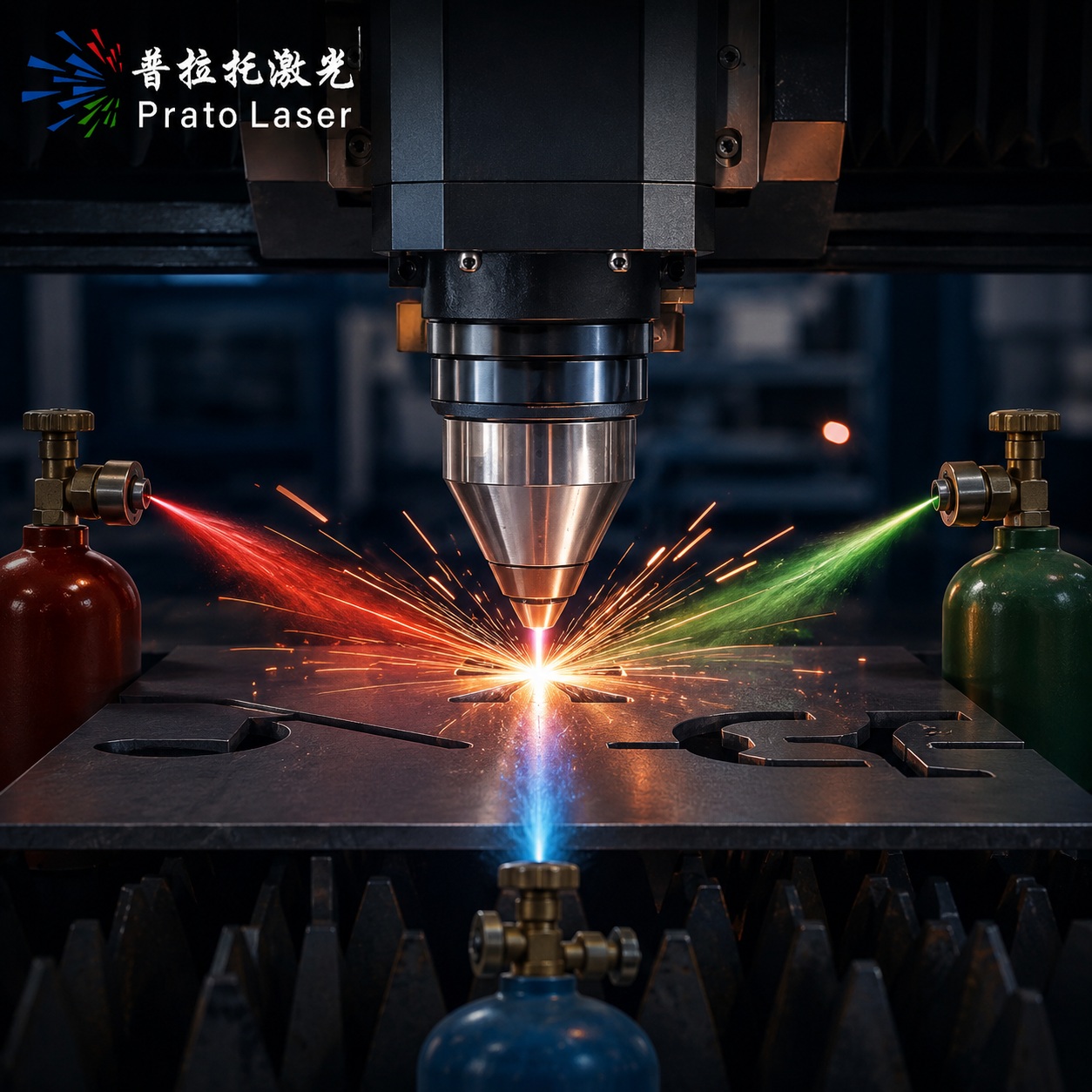
During laser cutting, the machine sends assist gas through the cutting head and nozzle together with the laser beam. It flows through the cutting head and nozzle into the kerf area.
Its main job is to remove molten metal from the cutting path. It also helps control heat, edge appearance, oxidation, and cutting stability.
Most sheet metal workshops use oxygen, nitrogen, or compressed air as assist gas. In some special applications, argon may also be used, but most sheet metal workshops mainly compare oxygen, nitrogen, and air.
A good assist gas setup should match the material type, thickness, laser power, cutting speed, nozzle size, and required edge quality.
For a general technical reference, Atlas Copco explains how laser cutting assist gases help remove molten material, improve cutting quality, and support cutting efficiency: Laser Cutting Process and Assist Gases.
Assist gas is not only a supporting element. It can change the final cutting result.
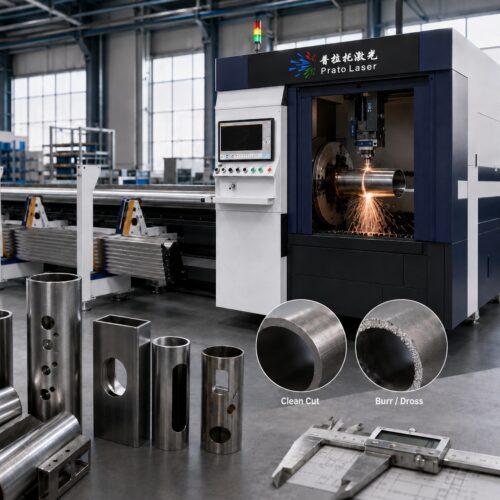
If the gas flow is stable and strong enough, molten metal can leave the kerf smoothly. This helps reduce burrs and improves bottom edge quality. If the gas flow is weak, unstable, or misaligned, molten metal may remain on the edge and form dross.
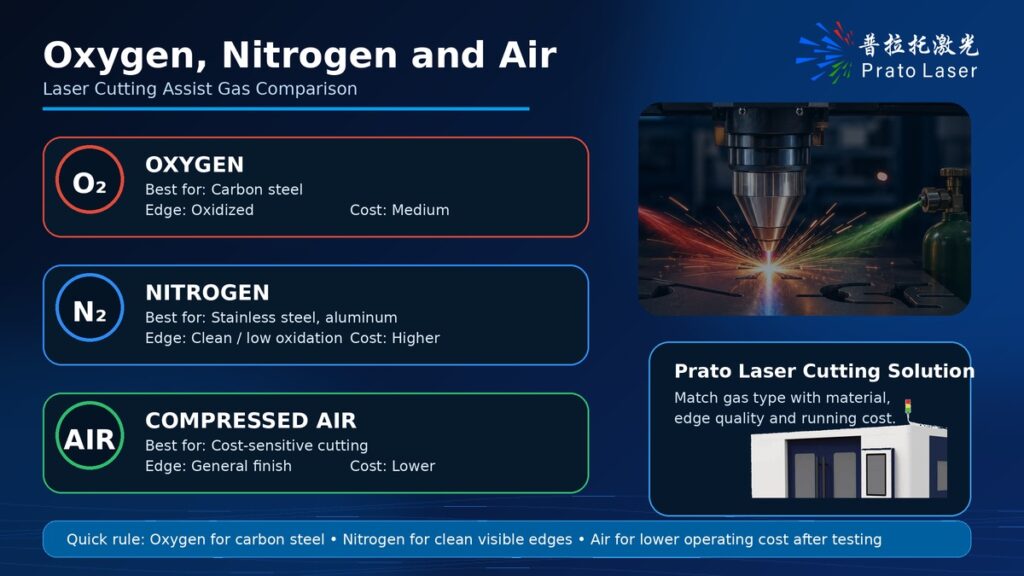
Assist gas also affects the color of the cut edge. For example, nitrogen can help reduce oxidation on stainless steel, while oxygen can leave an oxidized edge on carbon steel. Compressed air may reduce gas cost, but the edge finish may not match nitrogen in high-quality stainless steel applications.
Therefore, buyers should not ask only, “What power should I choose?” They should also ask, “What gas should I use for my material and edge requirement?”
Factories commonly use oxygen for carbon steel cutting. It reacts with hot metal and supports the cutting process through oxidation. This reaction can help improve cutting ability, especially on thicker carbon steel.
For many factories, oxygen cutting is practical because it can support strong cutting performance with lower gas flow compared with high-pressure nitrogen cutting.
However, oxygen also creates an oxidized edge. This may be acceptable for structural parts, machinery frames, brackets, and general carbon steel products. But if the edge needs painting, welding, or a clean appearance, the oxidation layer may require extra processing.
Oxygen cutting also needs careful control. If the oxygen pressure, cutting speed, or focus position is not suitable, the part may have heavy slag, rough edges, or overburning.
Oxygen is often suitable for:
Oxygen is usually not the first choice for stainless steel parts that require a bright and clean edge.
Factories widely use nitrogen when they need a cleaner edge and lower oxidation. It is an inert gas, so it does not react with the hot metal in the same way oxygen does.
For stainless steel, nitrogen is often preferred because it helps produce a brighter and cleaner edge. This is useful for kitchen equipment, elevator panels, decorative parts, cabinets, medical equipment, and visible stainless steel products.
Operators also use nitrogen for aluminum and some other non-ferrous metals. Since these materials can be sensitive to oxidation and surface quality, nitrogen can help improve the final appearance.
The main challenge is cost. Nitrogen cutting often requires higher pressure and higher gas consumption. Therefore, buyers should consider both edge quality and operating cost.
Nitrogen is often suitable for:
If edge appearance is important, nitrogen is usually the safer option.
Compressed air is another common option for fiber laser cutting. It contains nitrogen, oxygen, and other gases from the atmosphere. Many factories consider air cutting because it can reduce gas cost.
Compressed air can work well for some thin and medium-thick materials, especially when the product does not require a bright nitrogen-quality edge. It can be used for carbon steel, stainless steel, aluminum, and galvanized sheet in selected applications.
However, air cutting depends heavily on compressor quality, air pressure, filtration, dryness, and stability. If the air contains too much oil, water, or particles, it can affect cutting quality and damage the optical system.
For factories that want to use air cutting regularly, a stable compressor system and proper filtration are important.
Compressed air may be suitable for:
Air cutting can reduce operating cost, but buyers should test samples before using it for high-quality visible parts.
Each assist gas has its own strengths and limitations.
| Assist Gas | Best For | Main Advantage | Main Limitation |
|---|---|---|---|
| Oxygen | Carbon steel | Strong cutting support for steel | Oxidized edge |
| Nitrogen | Stainless steel, aluminum, visible parts | Cleaner edge and less oxidation | Higher gas cost |
| Compressed Air | Cost-sensitive sheet metal cutting | Lower operating cost | Edge quality depends on air system |
There is no single best gas for every job. The right choice depends on material, thickness, edge quality, speed, cost, and downstream processing.
Different metals respond differently to assist gas. Buyers should choose gas based on the material they cut most often.
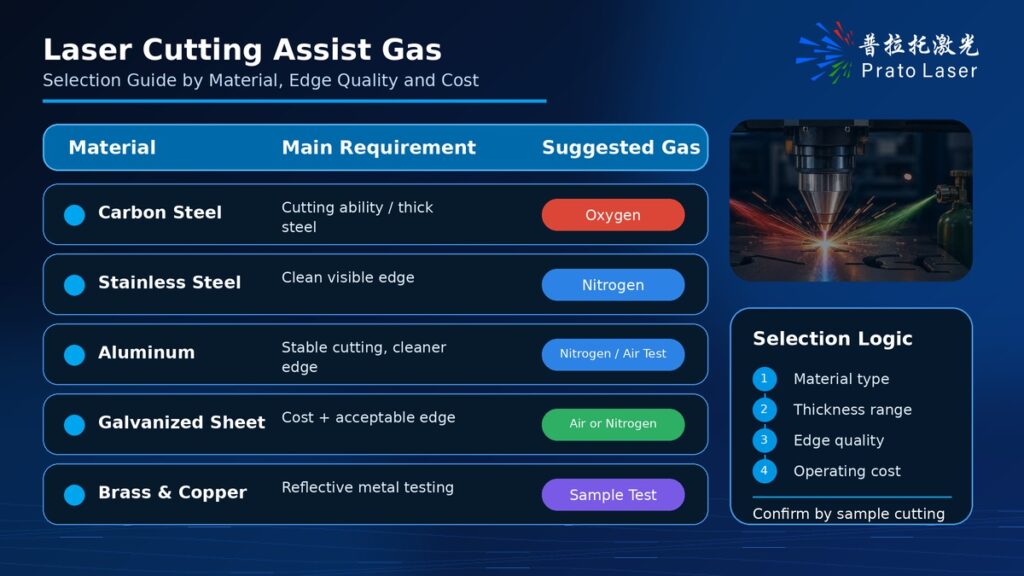
Carbon steel is often cut with oxygen, especially for medium and thick plates. Oxygen supports the cutting reaction and helps improve cutting ability.
For thin carbon steel, compressed air may also be used in some cost-sensitive applications. However, edge quality and burr level should be tested before regular production.
If the carbon steel part requires a cleaner edge for welding or painting, buyers should compare oxygen, nitrogen, and air through sample cutting.
Stainless steel is commonly cut with nitrogen when edge appearance matters. Nitrogen helps reduce oxidation and can produce a cleaner, brighter edge.
Factories can use compressed air for some stainless steel parts, especially when edge color is not critical. However, visible products such as kitchenware, elevator panels, and decoration parts usually benefit more from nitrogen cutting.
Aluminum is reflective and thermally conductive, so stable cutting parameters are important. Nitrogen is often used when buyers want cleaner aluminum edges.
Compressed air may also work in some production conditions, but buyers should test edge quality, burr level, and surface finish before choosing it as the main gas.
Operators can cut galvanized sheet with air or nitrogen, depending on product requirements. Since the coating can affect edge quality and fumes, buyers should test real material samples.
Brass and copper are highly reflective materials. They require careful power, focus, and gas settings. Operators often consider nitrogen for cleaner cutting, but buyers should request sample testing before confirming production parameters.
Laser Cutting Assist Gas has a strong influence on burr formation.
If gas pressure is too low, molten metal may stay in the kerf and solidify on the lower edge. This creates burrs or dross. If pressure is too high, airflow may become unstable and disturb the molten pool.
Nozzle condition also matters. Even with the right gas, a damaged or misaligned nozzle can create uneven gas flow. As a result, one side of the cut may be clean while the other side has burrs.
This is why assist gas should be checked together with cutting speed, focus position, laser power, nozzle size, and lens condition.
For more details, buyers can also read Prato Laser’s guide on Laser Cutting Burrs after publication.
Gas pressure is not fixed. It changes according to material, thickness, nozzle size, cutting speed, and gas type.
Thin materials usually need different pressure settings from thick plates. Stainless steel nitrogen cutting often requires high pressure, while oxygen cutting may use lower pressure because the oxidation reaction supports the cutting process.
Nozzle size also affects gas flow. A nozzle that is too small may restrict gas flow. A nozzle that is too large may reduce gas concentration. If the nozzle is damaged, dirty, or not centered, cutting quality can become unstable.
Operators should check the nozzle before making major parameter changes.
Gas purity can affect edge quality. Low-purity nitrogen may not protect stainless steel edges well enough. Poor oxygen quality can also affect cutting stability.
For compressed air cutting, air quality is especially important. Oil, water, and particles can create cutting problems and may damage the cutting head or protective lens. A good air system should include filtration, drying, stable pressure, and regular maintenance.
Factories that plan to use air cutting for long-term production should not treat compressed air as “free gas.” The compressor system, filtration system, and maintenance cost should be included in the total cost calculation.
Buyers can start with a simple rule.
For carbon steel, oxygen is often practical when cutting ability matters most and an oxidized edge is acceptable.
When edge quality, less oxidation, and a clean appearance are more important, nitrogen is usually the better choice.
Compressed air may work well when operating cost is a major concern and the product can accept a less perfect edge finish.
However, this rule is only a starting point. The final choice should be confirmed by sample cutting.
Before choosing Laser Cutting Assist Gas, buyers should confirm these points:
This checklist helps buyers avoid choosing gas only by cost or habit.
Sample cutting is the safest way to confirm assist gas performance.
Catalog data can show general cutting capacity, but real cutting results depend on material grade, surface condition, thickness, gas pressure, gas purity, cutting speed, focus, nozzle condition, and machine stability.
During sample cutting, buyers should check edge color, burr level, roughness, cutting speed, heat-affected zone, and part accuracy.
For stainless steel, aluminum, brass, copper, and galvanized sheet, sample cutting is especially useful.
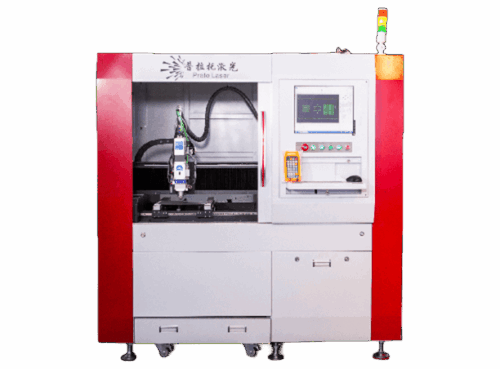
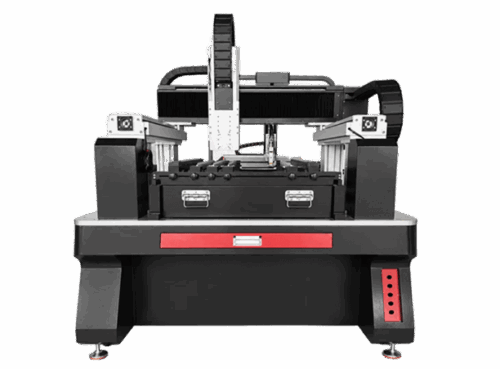
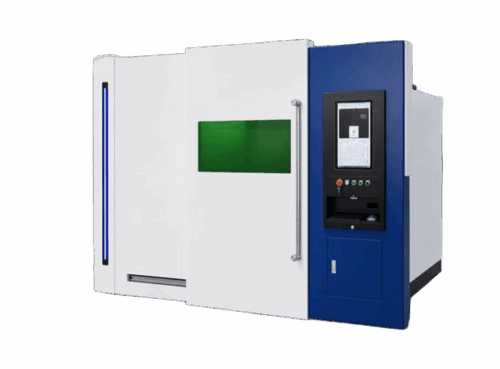
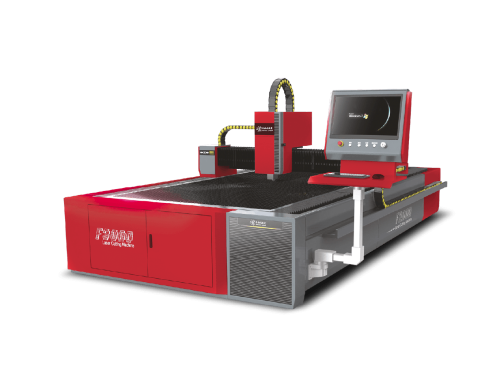
Prato Laser provides fiber laser cutting machine solutions for metal sheet cutting. According to production needs, buyers can choose different machine sizes, power ranges, and configurations for carbon steel, stainless steel, aluminum, galvanized sheet, brass, copper, and other metal materials.
For factories that need higher production efficiency, Prato Laser also offers high-speed fiber laser cutting machine solutions for industrial sheet metal processing.
If buyers are not sure whether oxygen, nitrogen, or air is suitable, Prato Laser can help evaluate material type, thickness, edge requirement, production volume, and operating cost.
Sample cutting and technical consultation can help buyers choose a more practical gas setup before confirming a machine configuration.
Laser Cutting Assist Gas affects much more than cutting speed. It influences edge quality, burr control, oxidation, operating cost, and downstream processing.
Oxygen is often used for carbon steel. Nitrogen is better for cleaner stainless steel and visible metal parts. Compressed air can reduce cost in some applications, but air quality and edge requirements must be checked carefully.
For buyers, the best gas is not always the cheapest option. The best gas is the one that matches the material, thickness, edge quality, and real production process.
Laser Cutting Assist Gas is the gas used during laser cutting to blow molten metal out of the kerf, control edge quality, and support the cutting process.
Nitrogen is often used for stainless steel because it helps reduce oxidation and creates a cleaner edge. Air can be used in some applications, but the edge quality may not match nitrogen cutting.
Oxygen is commonly used for carbon steel. It supports the cutting reaction and can help cut thicker mild steel, but it creates an oxidized edge.
Yes. Compressed air can be used for some sheet metal cutting applications. However, the air must be clean, dry, filtered, and stable. Buyers should test edge quality before using air cutting for high-quality parts.
Yes. Gas pressure, flow stability, nozzle condition, and gas type can all affect burr formation. Poor gas flow can leave molten metal on the edge and create dross.

English